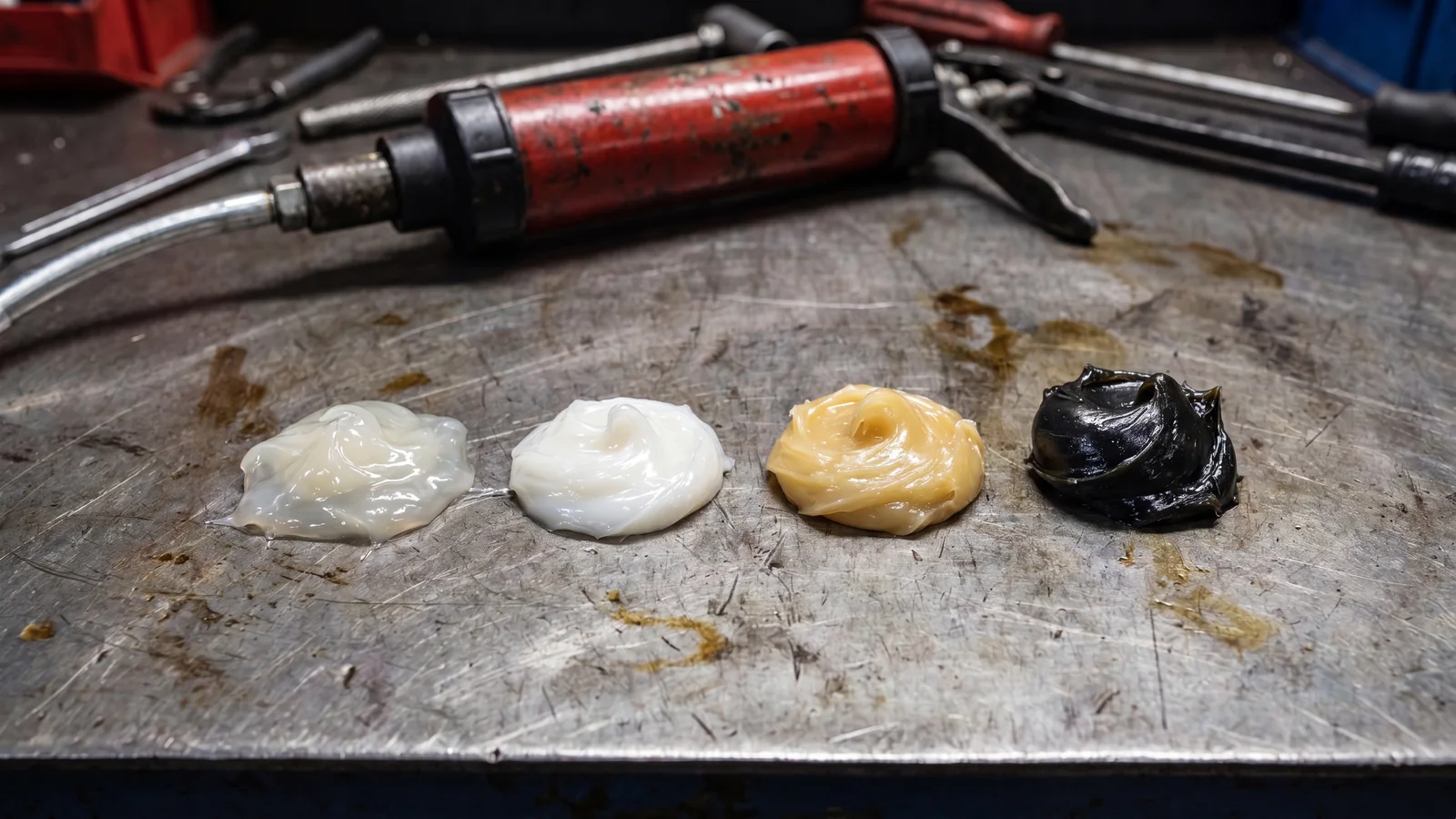
The NLGI class is the most quoted and, at the same time, the most over-stretched figure on a lubricating grease. It describes exactly one property — the consistency at 25 °C — and in practice it is read as if it also described pumpability, load-carrying capacity and operating limits. This article separates them cleanly: what the number contains, what it does not, and which data actually make a grease pump and a pipework network calculable.
In-depth on the topic: Grease pump for industry and mobile applications and clear criteria for the oil pump. These articles complement the system decision in practice, and the grease and oil pump range shows which designs handle which NLGI class.
What the NLGI class measures — and what it does not
The classification of the National Lubricating Grease Institute rests on a single standardised test: the worked penetration to DIN ISO 2137, equivalent in content to ASTM D217. A grease sample is worked in a grease worker with 60 double strokes and brought to 25 °C, after which a standardised cone falls into the sample for five seconds. The depth of penetration in tenths of a millimetre is the penetration number: the softer the grease, the deeper the cone, the higher the penetration number — and the lower the NLGI class.
| NLGI class | Worked penetration at 25 °C (0.1 mm) | Consistency |
|---|---|---|
| 000 | 445–475 | fluid, similar to a heavy oil |
| 00 | 400–430 | semi-fluid |
| 0 | 355–385 | very soft |
| 1 | 310–340 | soft |
| 2 | 265–295 | medium — the most widely used class |
| 3 | 220–250 | firm |
| 4 | 175–205 | very firm |
| 5 | 130–160 | block-like |
| 6 | 85–115 | hard, dimensionally stable |
Source: DIN ISO 2137 (worked penetration, 60 double strokes, 25 °C); classification of the National Lubricating Grease Institute.
Three things follow from this definition that are regularly overlooked in daily work. First, every class is a band of 30 units and not a single value: two greases of class 2 may differ by 30 tenths of a millimetre, and a soft NLGI 2 is closer to class 1 than to the firm end of its own class. Second, the measured value applies at 25 °C only; the class says nothing about the behaviour at −20 °C or at 100 °C. Third, it describes the thickener structure alone, not the base oil — and the base oil does the actual lubricating.
Why the NLGI class does not describe pumpability
Lubricating grease is not a Newtonian fluid. It has a yield point: below a certain shear stress it does not flow at all, and above it its apparent viscosity falls as the shear rate rises. The pressure drop along a lubrication line therefore cannot be extrapolated from a consistency number the way it can for an oil of known viscosity.
The relevant measured quantity is the flow pressure to DIN 51805, measured by the Kesternich method: the pressure needed to move the grease through a standardised test nozzle at a defined temperature. DIN 51825 ties the lower service temperature of a grease to exactly that: it is the lowest temperature at which the flow pressure does not exceed 1400 mbar. That is the figure that counts for a central lubrication system — not the NLGI class.
The reason lies in the temperature dependence of the consistency. A grease that falls cleanly into class 2 at 25 °C behaves considerably stiffer at −20 °C. The class on the container does not change; the pumpability in the pipework very much does. Sizing a grease pump for winter operation of a construction machine therefore needs the flow pressure over temperature, not a single consistency figure.
The second number: base oil viscosity
The load-carrying lubricating film between two surfaces is formed by the base oil, not by the thickener. Its viscosity is stated to DIN ISO 3448 as an ISO viscosity grade and refers to the kinematic viscosity at 40 °C; each grade covers its midpoint ± 10 %.
| Grade | Midpoint at 40 °C (mm²/s) | Permitted range (mm²/s) |
|---|---|---|
| ISO VG 32 | 32 | 28.8–35.2 |
| ISO VG 46 | 46 | 41.4–50.6 |
| ISO VG 68 | 68 | 61.2–74.8 |
| ISO VG 100 | 100 | 90–110 |
| ISO VG 150 | 150 | 135–165 |
| ISO VG 220 | 220 | 198–242 |
| ISO VG 320 | 320 | 288–352 |
| ISO VG 460 | 460 | 414–506 |
Source: DIN ISO 3448 — kinematic viscosity at 40 °C, each grade covers the midpoint ± 10 %.
Two greases of the same NLGI class may carry a base oil of ISO VG 100 or of ISO VG 460 — a factor of 4.6 in viscosity and therefore two fundamentally different applications. The NLGI class does not distinguish between them. As a rough direction in lubrication engineering: high speeds and moderate loads call for a thinner base oil, low speeds and high surface pressures for a thicker one. Comparing consistency alone means comparing the wrong number.
Reading the DIN 51825 designation code
DIN 51825 gathers the essential data into a designation code printed on every conforming container. It can be read in ten seconds once its structure is known — here using the example KP2K-30:
| Character | Meaning |
|---|---|
| K | lubricating grease for rolling and plain bearings and for enclosed gearboxes |
| P | contains additives to raise the scuffing load level (EP additives) and for corrosion protection |
| 2 | NLGI consistency class 2, that is 265–295 · 0.1 mm worked penetration |
| K | upper service temperature 140 °C; the letter also encodes the required water resistance to DIN 51807-1 |
| –30 | lower service temperature −30 °C, defined through the flow pressure to DIN 51805 |
Source: DIN 51825 (designation code and service temperatures), DIN 51807-1 (behaviour towards water), DIN 51805 (flow pressure). The full letter table of the temperature steps is in DIN 51825.
The designation code therefore carries three of the four data on which a system decision rests: consistency, temperature window and additive class. What it does not contain is the base oil viscosity and the thickener type. Both have to come from the data sheet, and both matter.
What this means for sizing
The consistency changes how a grease pump takes up the medium and moves it through lines and distributors. In a compact system with short runs and a constant hall temperature that hardly matters. Long lines, cold surroundings and many lubrication points shift the picture considerably, because the resistance is made up of line length, cross-section, distributor resistance and the flow pressure of the medium — and only the last of these is on the container.
For sizing, that means in concrete terms:
- never assess the consistency without the temperature window in which the plant actually starts up — not the one in which it runs
- ask for the flow pressure to DIN 51805 at the lowest operating temperature, not only for the NLGI class
- calculate line length, cross-section and distributor resistances as one chain, not as separate items
- plan a delivery reserve: a theoretically suitable grease is unsuitable in practice if no reserve remains between system pressure and demand
- take the consistency limits of the pump used from its own data sheet — they depend on the design and cannot be derived from the NLGI class
Typical misunderstandings
“Firmer lubricates better.” The load-carrying capacity of the lubricating film comes from the base oil viscosity and the additives, not from the consistency. A firmer grease stays in place better, which is an advantage at open lubrication points — but it does not build a better film.
“NLGI 2 is NLGI 2.” The class is a band of 30 units and says nothing about the thickener type — lithium, lithium complex, calcium sulphonate or polyurea. The thickener type decides miscibility: incompatible thickeners can soften or harden the mixture even though both starting greases carry the same class.
“The pump delivers every class.” Pumpability is not a property of the grease alone but of the interplay of medium, temperature, pipework and system type. The same class can be unremarkable in summer and marginal in winter on the same plant.
What this means for purchasing and maintenance
The most common avoidable mistake is a change of medium secured through the NLGI class alone — same class, different base oil, different thickener. Afterwards the pressure behaviour of the plant changes, and the cause is looked for in the unit instead of in the medium.
For a change to be decidable, four data belong in every enquiry and every release:
- NLGI consistency class to DIN ISO 2137
- base oil viscosity as ISO VG at 40 °C to DIN ISO 3448
- service temperature range through the designation code to DIN 51825, with the lower end secured through the flow pressure to DIN 51805
- thickener type, because it decides miscibility with what is already in the system
With those four side by side, an alternative product can be assessed on the facts. Without them, the comparison stays a price decision with a technical residual risk.
Practical recommendation
Always check the NLGI class together with base oil viscosity, temperature window, line length and system type. Only then does a consistency figure become a sound technical decision. The order that has proven itself: first define the temperature window of the plant, derive the lower service temperature and the flow pressure from it, then choose the base oil viscosity from load and speed — and the NLGI class last, as what it is: the consistency in which this grease is run.
Standards and sources
All figures in this article come from published standards and can be verified there. Product-specific values — delivery rates, working pressures, permissible consistency ranges of individual pumps — are deliberately not included; they belong in the respective data sheet.
- DIN ISO 2137 — determination of cone penetration (worked penetration); equivalent in content to ASTM D217
- DIN ISO 3448 — ISO viscosity classification for liquid industrial lubricants
- DIN 51825 — K lubricating greases, classification, designation codes and service temperatures
- DIN 51805 — determination of the flow pressure of lubricating greases, Kesternich method
- DIN 51807-1 — testing the behaviour of lubricating greases towards water